
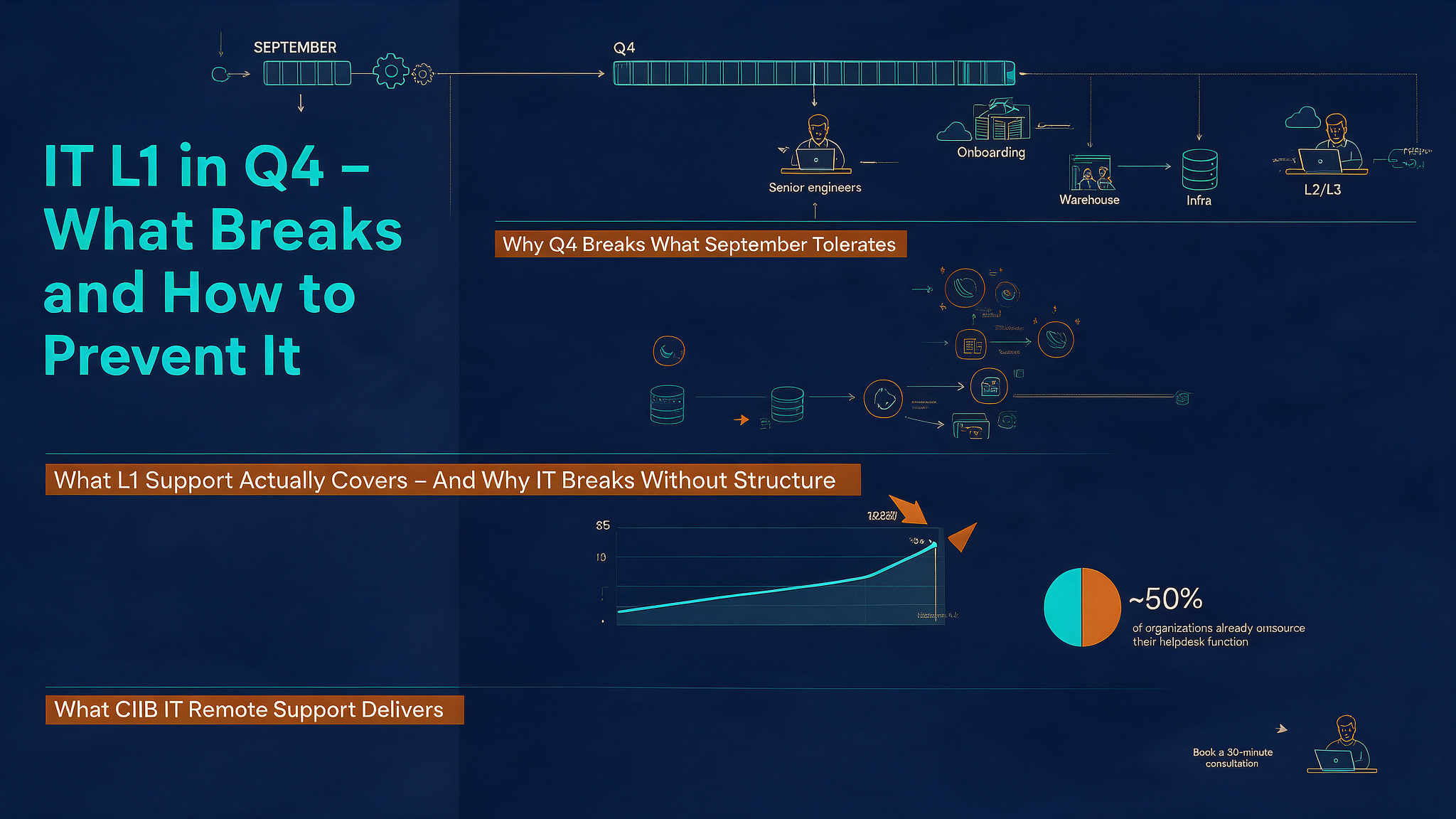
Every October, the same pattern plays out inside DACH e-commerce IT teams. A seasonal hire can’t access the order management system on day one. A warehouse scanner won’t sync over VPN during peak processing hours. A password reset ticket sits in queue behind twelve others, because the person who’d normally handle it is in a meeting about Black Friday infrastructure readiness.
None of this is a surprise. It happens every year, at roughly the same volume, for the same reasons. And most IT teams still don’t build for it.
Why Q4 Breaks What September Tolerates
In September, a thin L1 layer is an inconvenience. Tickets take a little longer. A senior engineer loses an hour here and there to basic requests. It’s inefficient, but it doesn’t visibly break anything.
Q4 changes the math. Seasonal staff onboard in waves, each one needing device setup, system access, and account provisioning within days, not weeks. Transaction volume climbs, and with it, the number of access requests, password resets, and connectivity issues. At the same time, the people best equipped to handle infrastructure decisions, capacity planning, failover testing, the cloud migration that’s been paused since summer, are the same people fielding L1 tickets, because there’s no dedicated layer to absorb them.
This is exactly the kind of seasonal spike a structured L1 layer is built to absorb, without a hiring cycle. Rightshored teams can flex to meet Q4 volume without the lead time of recruiting, onboarding, and training seasonal internal hires, then scaling back down once peak season ends (Source: iShape Technologies, 2026).
The result is a structural bottleneck that shows up as a service problem but is really a staffing model problem.
What L1 Support Actually Covers – And Why It Breaks Without Structure
L1 support is meant to be the shock absorber: the first point of contact for the high-volume, lower-complexity issues that make up the bulk of any helpdesk queue. Password resets, VPN reconnections, M365 and Windows access requests, onboarding and offboarding, basic software troubleshooting.
In a well-structured setup, L1 resolves the majority of these on first contact and escalates the rest with enough context that L2 doesn’t have to start from zero. In an under-resourced setup, L1 either doesn’t exist as a distinct function, or it’s staffed too thin to absorb Q4 volume, so requests bypass it entirely and land on whoever’s available. That’s usually the most senior person in the room, because they’re the one who can solve anything, including things far below their actual role.
This is where the cost shows up. Rightshored IT helpdesk delivery reduces total support costs by 30–50%, by matching skill level to task rather than routing everything through senior staff (Source: FusionCX IT Helpdesk Outsourcing Guide, 2026).
The global market reflects this shift. The global helpdesk outsourcing market is projected to reach $18.3 billion by 2033 (Source: Auxis / Computer Economics, 2026), and roughly half of organizations already outsource their helpdesk function in some form (Source: Computer Economics, citing Auxis, 2026) – a sign this is becoming standard practice rather than an edge case.
What CIIB IT Remote Support Delivers
CIIB IT Remote Support provides IT helpdesk outsourcing for Switzerland and the wider DACH region, structured across three levels:
L1 Service Desk – M365, Windows 11, VPN, user onboarding and offboarding, software support, and continuous SLA monitoring. This is the layer that absorbs Q4 volume before it reaches your senior team.
L2 Infrastructure & Cloud – ITIL-based incident management, Windows Server, VMware, Azure, backup, and M365 tenant administration. Complex enough to need real expertise, routine enough that it doesn’t need your architecture lead.
L3 IT Projects – for work that requires deeper technical ownership, handled in coordination with your internal team rather than in place of it.
The setup is built for Swiss and DACH compliance requirements: ISO 27001-certified, GDPR-compliant, with SLAs designed to hold at peak Q4 volume rather than degrade under it.
The cost case holds up independent of seasonality. Outsourced 24/7 IT coverage typically runs 20–40% lower than staffing equivalent internal shifts (Source: iShape Technologies, 2026) – a gap that widens further during Q4, when internal coverage would otherwise mean overtime, temporary hires, or gaps in after-hours support.
Onboarding runs 2–4 weeks, which means a team that starts the process in October can be live well before the seasonal peak hits.
For companies evaluating remote IT support DACH-wide, the practical questions are usually the same: can this partner handle our compliance requirements, will response times hold under seasonal load, and how much senior engineering time will this actually free up. Those are the questions a 30-minute conversation can usually answer.
See What Your Team Gets Back
If your senior engineers are already absorbing L1 tickets in September, Q4 will make it worse. Not because anything changes about the work, but because volume exposes what structure was covering for.
CIIB offers a free 30-minute consultation to walk through your current setup and where a structured L1 helpdesk would change the math for your team this quarter.